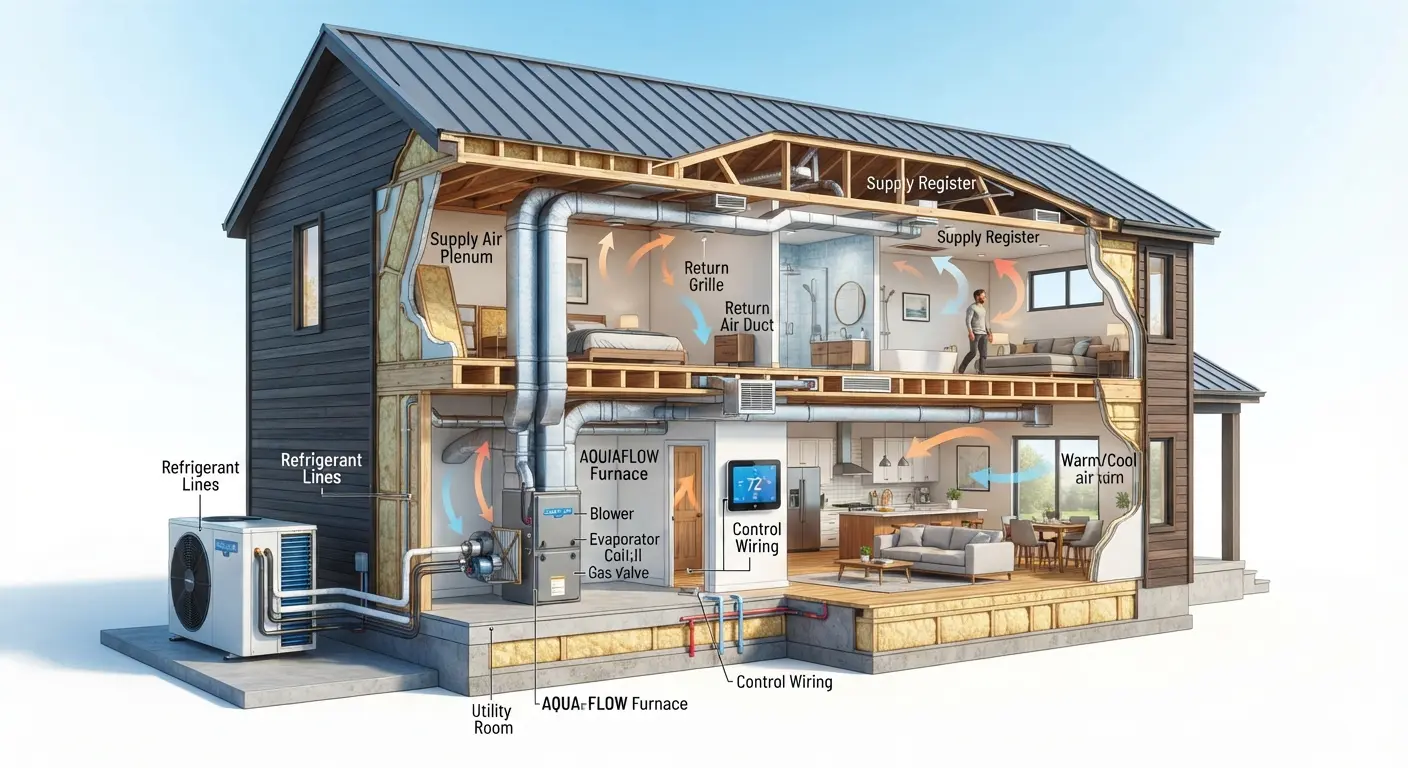
How to Choose a Heating and Air Conditioning System for Your Home
Choosing a new heating and cooling system is not simply a matter of finding the highest SEER2 rating or replacing your old equipment with a newer version of the same size.
If you’re wondering how to choose a heating and air conditioning system, start with your home’s actual heating and cooling requirements. The right HVAC system depends on your climate, calculated heating and cooling load, existing ductwork, available fuel or electricity, comfort preferences, equipment efficiency, installation quality, and long-term ownership cost.
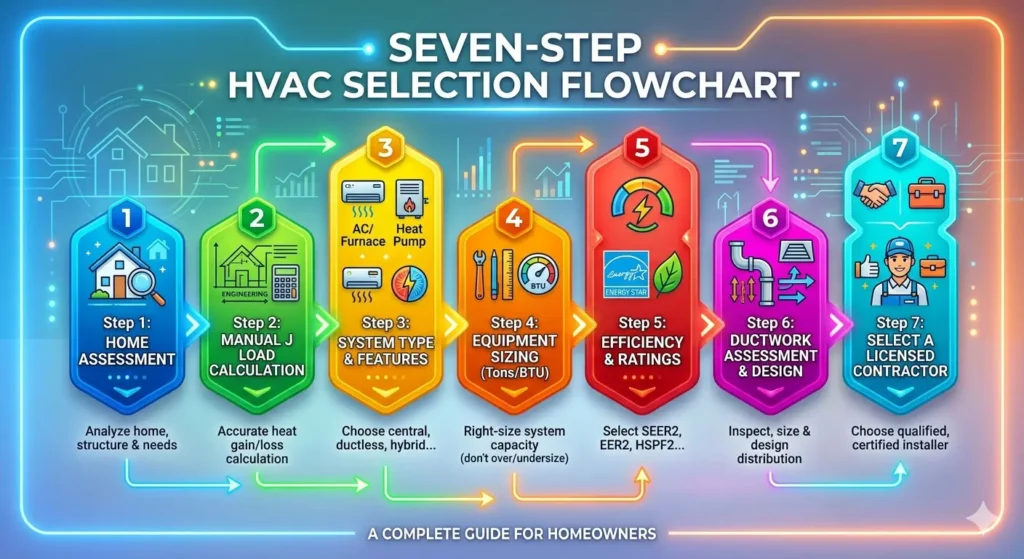
For most homeowners, the best HVAC selection process follows this order:
- Understand your home’s heating and cooling needs.
- Have a proper load calculation performed.
- Decide which HVAC system type fits the house.
- Match equipment capacity to the calculated load.
- Evaluate efficiency and comfort features.
- Inspect or design the duct system.
- Compare complete contractor proposals rather than equipment prices alone.
That approach is far more reliable than choosing by brand name, square footage, tonnage, or price alone.
How to Choose the Right HVAC System: Quick Decision Guide
The right HVAC system is the one that can maintain comfortable indoor temperatures and humidity efficiently under the conditions your particular home experiences.
Before choosing an HVAC system, consider these seven factors:
| Factor | What to Evaluate |
|---|---|
| Climate | Summer heat, humidity, winter lows and seasonal extremes |
| Heating/cooling load | A professional Manual J calculation |
| Existing infrastructure | Ductwork, electrical service, gas connection and equipment location |
| System type | Heat pump, furnace + AC, mini-split, dual-fuel, geothermal or packaged equipment |
| Efficiency | SEER2, HSPF2, AFUE and actual operating conditions |
| Comfort | Humidity control, zoning, noise and variable-speed operation |
| Ownership cost | Installation, energy, maintenance, repairs and expected time in the home |
The most important point is that HVAC selection should begin with the house—not with an equipment catalog.
Start With Your Home, Not an HVAC Brand
A heating and air conditioning system interacts with the entire building.
Two houses with the same floor area may require different equipment because their insulation, windows, orientation, air leakage, ceiling heights, occupancy, ductwork and climates differ.
Consider Your Local Climate
Climate influences both the type of HVAC system and the performance characteristics you should prioritize.
A homeowner in a hot, humid part of the Southeast may place greater emphasis on cooling performance and moisture removal. A home in a northern climate must account for winter heating performance at low outdoor temperatures. A dry Southwestern climate presents a different cooling load again.
Modern air-source heat pumps can work in far more climates than older generations of equipment. The U.S. Department of Energy notes that advances in heat-pump technology have made air-source systems a legitimate heating option even in colder regions.
That does not mean every heat pump is equally suitable for every climate. Cold-weather performance, equipment capacity at the local design temperature, backup heat and electricity costs still need to be evaluated.
Check Your Existing Ductwork
Existing ductwork can strongly influence HVAC system selection.
If your home already has well-designed, properly sized and reasonably tight ducts, a ducted furnace, central air conditioner or ducted heat pump may be straightforward to consider.
If the house has no ducts—or the ducts are difficult or expensive to correct—a ductless mini-split system may deserve much more attention.
ENERGY STAR describes ductless mini-split heat pumps as heating and cooling systems that do not require ductwork and can serve one or multiple zones.
Do not assume, however, that existing ducts are automatically good ducts. Leakage, inadequate return airflow, poor insulation and incorrect sizing can undermine the performance of new equipment.
Consider the Building Envelope
Before spending extra money on larger HVAC equipment, consider whether excessive heating and cooling demand is being caused by the building itself.
Important factors include:
- Attic and wall insulation
- Air leakage
- Window performance
- Solar heat gain
- Door leakage
- Shading
- Ceiling height
- Duct location
- Orientation of the home
Improving some of these conditions can change the heating and cooling load and potentially allow a different equipment choice.
What Type of HVAC System Should You Choose?
There is no single best HVAC system for every U.S. home.
A better question is: Which system type best matches my house, climate, energy sources and comfort priorities?
Central Air Conditioner and Furnace
A traditional split system commonly combines a central air conditioner for cooling with a furnace for heating.
It can be a practical option when:
- The home already has suitable ductwork.
- Natural gas or another furnace fuel is readily available.
- Strong winter heating performance is important.
- The homeowner prefers a familiar central forced-air system.
The main trade-off is that heating and cooling are handled by separate primary technologies rather than one reversible system.
Air-Source Heat Pump
A heat pump can provide both heating and cooling by transferring heat rather than generating all of its heat directly.
During cooling, it moves heat out of the house. During heating, the refrigeration cycle reverses and moves available heat into the home.
DOE describes heat pumps as an energy-efficient alternative to separate furnaces and air conditioners and notes that modern systems are suitable across a broad range of climates.
A heat pump deserves consideration when:
- You want one system for heating and cooling.
- Electricity economics in your area are favorable.
- You are reducing reliance on combustion heating.
- Appropriate cold-climate equipment is available where winters are severe.
Ductless Mini-Split Heat Pump
A mini-split uses an outdoor unit connected to one or more indoor units without conventional central ductwork.
It can be particularly useful for:
- Older houses without ducts
- Additions
- Finished garages
- Bonus rooms
- Individual problem areas
- Zoned comfort
- Homes where adding ducts would be disruptive
For a whole-house installation, equipment placement and zoning design matter. Multiple indoor heads do not automatically guarantee even comfort.
Dual-Fuel or Hybrid HVAC System
A dual-fuel arrangement typically combines a heat pump with a furnace.
The heat pump can provide heating during suitable outdoor conditions while the furnace can take over when appropriate.
This configuration may be worth investigating where homeowners want heat-pump benefits while retaining another high-capacity heating source for colder conditions.
The changeover strategy should be based on equipment performance, climate and energy economics rather than an arbitrary outdoor temperature.
Geothermal Heat Pump
A geothermal or ground-source heat pump exchanges heat with the ground instead of relying primarily on outdoor air.
DOE notes that geothermal systems can offer high efficiency and long ground-loop life, but installation can cost considerably more than an air-source system.
Geothermal may be worth evaluating when:
- The property is suitable for the ground loop.
- You expect to remain in the home for a long period.
- High upfront installation cost is acceptable.
- Long-term efficiency is a major priority.
Packaged HVAC System
Packaged systems place major heating and cooling components in one cabinet, often outdoors.
They are used in certain homes where space, architecture or existing system design makes a packaged configuration practical.
They should be evaluated by the same standards as other systems: load, climate, efficiency, airflow, installation quality and lifecycle cost.
How Do I Know What Size HVAC System I Need?
Do not choose HVAC capacity from square footage alone.
Correct sizing requires estimating how much heat the house gains in summer and loses in winter.
For residential systems, one of the most important entities to understand is ACCA Manual J.
The Air Conditioning Contractors of America identifies Manual J as the ANSI-recognized residential standard for calculating heating and cooling loads.
A proper load calculation considers factors such as:
- Local design temperatures
- Insulation
- Windows
- Building orientation
- Air leakage
- Occupancy
- Internal heat gains
- Ceiling height
- Duct gains and losses
Manual J Does Not Mean “Pick a Unit With the Same Number”
There is another important distinction.
Manual J calculates the building’s load. Equipment selection follows separately.
ACCA explains the broader process through three commonly referenced design methods:
Manual J: calculates heating and cooling loads.
Manual S: helps select equipment based on those loads and actual manufacturer performance data.
Manual D: addresses residential duct-system design.
This J → S → D relationship is one of the most useful concepts a homeowner can understand when comparing HVAC proposals.
Why an Oversized HVAC System Can Be a Problem
A bigger air conditioner or heat pump is not automatically better.
Oversizing may contribute to:
- Frequent starting and stopping
- Uneven temperatures
- Poor humidity removal
- Unnecessary equipment cost
- Additional wear
- Reduced comfort
What About an Undersized System?
An undersized system may struggle to maintain the target temperature during design conditions and can operate for very long periods without meeting the home’s load.
The goal is therefore not “largest possible” or “smallest possible.”
It is correctly selected capacity for the calculated load and actual equipment performance.
Understanding SEER2, HSPF2 and AFUE
HVAC efficiency labels can be useful, but they should not be considered in isolation.
What Is SEER2?
SEER2, or Seasonal Energy Efficiency Ratio 2, is a seasonal cooling-efficiency metric used for central air conditioners and heat pumps.
A higher SEER2 value generally represents greater rated seasonal cooling efficiency when comparing appropriate equipment under standardized test conditions.
What Is HSPF2?
HSPF2, or Heating Seasonal Performance Factor 2, expresses seasonal heating performance for heat pumps.
DOE currently uses SEER2 and HSPF2 as the principal cooling and heating efficiency metrics for central air conditioners and heat pumps under the applicable test procedure.
What Is AFUE?
For furnaces, Annual Fuel Utilization Efficiency (AFUE) represents the proportion of fuel energy converted into useful heat over a typical operating cycle.
AFUE should not be compared directly with SEER2 because they measure different equipment and different aspects of performance.
Does a Higher Efficiency Rating Always Pay for Itself?
Not necessarily.
Whether a higher-efficiency model produces an attractive financial return depends on:
- Climate
- Local energy prices
- How often the system operates
- Difference in equipment price
- Home insulation and leakage
- Duct performance
- Expected ownership period
- Installation quality
Instead of asking, “What is the highest SEER2 system I can buy?” ask:
“What efficiency level provides the best combination of comfort, operating cost and purchase price for this home?”
Heat Pump vs. Furnace and Air Conditioner
This is one of the most common decisions when choosing a new HVAC system.
| Consideration | Heat Pump | Furnace + AC |
|---|---|---|
| Cooling | Yes | AC provides cooling |
| Heating | Yes | Furnace provides heating |
| Primary energy source | Usually electricity | Electricity for AC; furnace fuel varies |
| Ducted options | Yes | Yes |
| Ductless option | Yes | Not in the traditional central configuration |
| Cold-climate capability | Depends on model and design | Furnace can provide strong cold-weather heating |
| One primary reversible system | Yes | No |
| Best choice | Depends on climate, utilities, load and home | Depends on climate, fuel, ducts and homeowner priorities |
A contractor should compare actual equipment performance at your local design conditions, not simply repeat the outdated assumption that heat pumps cannot work in cold climates.
Central HVAC vs. Ductless Mini-Split
Choose between central and ductless systems based primarily on the house.
A central ducted system often makes sense when good ductwork already serves the home.
A ductless system becomes particularly attractive when:
- There are no existing ducts.
- New duct installation would be expensive.
- Different zones have very different comfort needs.
- You are conditioning an addition or isolated space.
Do not decide from equipment efficiency alone. Distribution matters just as much as the machine producing the heating or cooling.
Don’t Ignore the Duct System
One of the biggest HVAC buying mistakes is replacing the equipment while assuming the air-distribution system is fine.
Ask the contractor to evaluate:
- Supply ducts
- Return ducts
- Leakage
- Insulation
- Static pressure
- Airflow
- Register placement
- Return-air capacity
- Duct sizing
ACCA’s design framework separates load calculation, equipment selection and duct design because they are related but distinct parts of a functioning HVAC system.
A premium outdoor unit cannot compensate for severely restricted airflow or badly designed distribution.
Single-Stage, Two-Stage or Variable-Speed HVAC?
Capacity control influences both comfort and price.
Single-Stage Equipment
Single-stage equipment generally operates at one primary capacity when running.
Its advantages can include simplicity and lower upfront price.
Two-Stage Equipment
Two-stage equipment can operate at a lower and higher output.
This may improve temperature consistency and part-load operation compared with a simple single-stage system.
Variable-Speed or Inverter-Driven Equipment
Variable-capacity systems can modulate output across a wider operating range.
DOE notes that staged and inverter-driven heat-pump compressors can operate closer to the capacity required at changing outdoor temperatures, reducing unnecessary on/off cycling.
Potential advantages include:
- More stable indoor temperatures
- Better humidity control in suitable applications
- Quieter operation
- Longer operating cycles at lower output
- Greater comfort
The trade-off is generally greater equipment complexity and upfront cost.
What Type of HVAC System Do I Have?
If you are replacing equipment, identifying your existing system helps you understand which parts might be reusable.
Look for an Outdoor Unit
A central air conditioner and an air-source heat pump can look similar outdoors.
Check the equipment’s model information and thermostat controls rather than relying only on appearance.
A heat pump normally provides both heating and cooling through the refrigeration system.
Look at the Indoor Equipment
Common possibilities include:
Furnace: usually has a burner or other heat source and a blower.
Air handler: commonly paired with a heat pump or central cooling system.
Evaporator coil: often installed near a furnace or within an air handler.
Ductless indoor unit: typically mounted on a wall, ceiling or concealed in a small ducted zone.
Check Your Thermostat
A thermostat with settings or wiring associated with auxiliary/emergency heat may indicate a heat-pump system, although thermostat design varies.
Check the Model Number
The most reliable homeowner-friendly approach is to locate the manufacturer name and model number on the indoor and outdoor units and verify the equipment type through manufacturer documentation or a qualified HVAC professional.
Check the Complete Matched HVAC System
Do not compare only outdoor condensers.
An HVAC system’s rated performance can depend on the combination of outdoor equipment, indoor coil, air handler or furnace.
Ask for the AHRI Certified Reference Number when applicable.
The Air-Conditioning, Heating, and Refrigeration Institute maintains the AHRI Directory of Certified Product Performance, which allows consumers and professionals to verify certified HVACR product ratings.
This helps you compare the actual proposed equipment combination instead of relying only on marketing claims.
Ask About the Refrigerant in New Equipment
Refrigerant should not decide your entire purchase, but it is worth discussing with the contractor.
The U.S. HVAC market is undergoing changes related to hydrofluorocarbon refrigerants. EPA currently lists refrigerants including R-454B and R-32 as acceptable for specified residential and light-commercial air-conditioning and heat-pump applications subject to applicable use conditions.
Ask:
- Which refrigerant does this system use?
- Is the installer trained to service it?
- Are required safety and installation procedures being followed?
- What does future service availability look like?
Regulations can change, so use current EPA information rather than relying on an old HVAC buying article.
Compare Total Ownership Cost, Not Just Installation Price
The cheapest proposal today is not necessarily the least expensive system to own.
Consider:
Purchase and installation: equipment, labor, permits, electrical work, duct modifications and accessories.
Energy: estimated heating and cooling consumption under your local utility rates.
Maintenance: filters, tune-ups and manufacturer-recommended service.
Repairs: equipment complexity, warranty coverage and local parts/service availability.
Expected ownership: a premium efficiency upgrade has less time to recover its additional cost if you expect to move soon.
The useful comparison is therefore:
Installed price + estimated operating cost + maintenance/repair exposure + expected ownership period.
What About HVAC Rebates and Federal Tax Credits in 2026?
Always verify incentives using current sources before including them in your purchasing calculation.
An important 2026 update is that the federal Energy Efficient Home Improvement Credit currently applies to qualifying property placed in service through December 31, 2025. IRS guidance states that the credit cannot be claimed for qualifying property placed in service after that date.
That means homeowners shopping in 2026 should not rely on older articles that automatically promise a federal heat-pump tax credit.
However, state, local, utility or manufacturer programs may still exist. Check programs available for your ZIP code before purchasing.
Why the HVAC Contractor Matters as Much as the Brand
A premium system can perform poorly if it is incorrectly sized, selected, installed or commissioned.
When evaluating contractors, look beyond the brand logo on their truck.
Ask whether the contractor will:
- Perform a Manual J calculation
- Explain the proposed capacity
- Inspect existing ductwork
- Match equipment using manufacturer performance data
- Provide AHRI certification information where applicable
- Check airflow
- Handle required permits
- Explain equipment and labor warranties
- Commission and test the completed system
- Provide a written scope of work
Trane’s current homeowner replacement guidance similarly warns against relying on contractors who skip load calculations and simply replace an existing system with the same nominal size.
Questions to Ask Before Buying an HVAC System
Bring these questions to every estimate:
- What are my Manual J heating and cooling loads?
- What system capacity are you proposing and why?
- Why is this type of HVAC system appropriate for my home?
- Are you using Manual S or equivalent performance-based equipment selection?
- Have you inspected the supply and return ductwork?
- What are the system’s SEER2, HSPF2 or AFUE ratings?
- What will the equipment deliver at our local design temperatures?
- What is the AHRI Certified Reference Number for the proposed combination?
- Is the equipment single-stage, two-stage or variable-capacity?
- What refrigerant does it use?
- What electrical, gas or duct modifications are included?
- What permits are required?
- What manufacturer warranty applies?
- What labor warranty is included?
- What maintenance is required?
- Are any current utility, state or local incentives available?
A contractor who can explain these answers clearly is providing much more useful information than one who simply quotes a tonnage and price.
Common HVAC Selection Mistakes
Choosing by Square Footage Alone
Square footage is only one input affecting heating and cooling load. Insulation, windows, leakage, climate and other factors matter.
Assuming Bigger Is Better
Oversized equipment can sacrifice comfort and humidity control.
Replacing the Old Unit With the Same Size Automatically
The old equipment may itself have been oversized, or the house may have changed since it was installed.
Shopping Only by Brand
Installation and system design can be as important as the equipment badge.
Chasing the Highest Efficiency Rating
A high laboratory efficiency rating does not automatically provide the best economic outcome for every home.
Ignoring Ductwork
Poor airflow can compromise even excellent equipment.
Choosing the Lowest Bid Without Comparing Scope
One proposal may include load calculations, duct corrections, permits and commissioning while another does not.
Compare what is actually being installed.
Which HVAC System Should You Investigate First?
Use this as a starting point rather than a substitute for professional design.
| Your Home or Priority | System Worth Investigating First |
|---|---|
| Good ducts and existing gas infrastructure | Furnace + central AC or dual-fuel |
| Good ducts and preference for electric heating/cooling | Ducted heat pump |
| No existing ducts | Ductless mini-split heat pump |
| Addition or difficult individual room | Mini-split |
| Very cold winters | Cold-climate heat pump, dual-fuel or furnace-based options |
| Strong interest in zoning | Multi-zone ductless or designed ducted zoning |
| Long ownership horizon and suitable property | Geothermal |
| Need simple conventional replacement | Properly sized central split system |
The final choice should still be based on the home’s load and actual equipment performance.
Final HVAC Buying Checklist
Before signing a contract, confirm that you know:
- Your home’s calculated heating and cooling load
- The recommended HVAC system type
- Proposed equipment capacity
- Why that capacity was selected
- SEER2/HSPF2/AFUE ratings where applicable
- Condition of existing ductwork
- Whether duct modifications are required
- Equipment staging or variable-capacity features
- AHRI-certified equipment combination
- Refrigerant type
- Installation scope
- Permit requirements
- Manufacturer warranty
- Labor warranty
- Estimated operating implications
- Current incentives available locally
If a proposal cannot clearly answer those questions, get another opinion.
Frequently Asked Questions
How do I choose the right HVAC system?
Start with a professional heating and cooling load calculation, then compare system types according to climate, existing ductwork, available energy sources, efficiency, comfort needs and total ownership cost. Equipment should be selected to match the calculated load rather than chosen from square footage alone.
How do I know what size HVAC system my house needs?
A qualified professional should perform a residential load calculation such as ACCA Manual J. It accounts for factors including climate, insulation, windows, orientation and air leakage. The calculated load is then used as part of the equipment-selection process.
Is a bigger HVAC system better?
No. Bigger HVAC equipment is not automatically better. Oversized equipment may cycle excessively and can reduce temperature and humidity control. Correctly matched capacity is more important than simply buying a larger unit.
Is a heat pump better than a furnace and central AC?
Neither is universally better. Heat pumps can provide efficient heating and cooling from one system, while a furnace and central AC combination may make sense where existing gas infrastructure, very cold conditions or local energy economics favor it. Compare both against your home’s actual load and local climate.
What is the difference between SEER2 and HSPF2?
SEER2 evaluates seasonal cooling efficiency, while HSPF2 measures seasonal heating efficiency for heat pumps. They describe different operating modes and should be evaluated alongside capacity, climate and operating costs.
What type of HVAC system do I have?
Look at both the indoor and outdoor equipment, thermostat, manufacturer label and model numbers. Common systems include a furnace with central AC, ducted heat pump, ductless mini-split, packaged system or geothermal heat pump. A contractor or manufacturer documentation can confirm the configuration from the model numbers.
Is central HVAC better than a mini-split?
Central HVAC is often a logical option when a home already has suitable ductwork and needs whole-house conditioning. A mini-split can be more practical for houses without ducts, additions, individual problem rooms or applications requiring independent zones.
Does HVAC brand matter?
Brand matters for features, warranty, parts availability and equipment quality, but it should not replace proper design and installation. Correct sizing, matching indoor and outdoor equipment, airflow, ductwork and contractor quality can have a major influence on actual performance.
Should I replace my furnace and air conditioner at the same time?
Sometimes, but not automatically. If components are designed to operate together, equipment age, compatibility, efficiency, refrigerant, warranty and installation cost should all be evaluated. Ask the contractor to explain the advantages and disadvantages of replacing one component versus the matched system.
Final Thoughts: Choosing an HVAC System Is a Design Decision
Learning how to choose an HVAC system becomes easier once you stop treating HVAC equipment like a stand-alone appliance.
The right system is part of a building.
Start with the home’s heating and cooling loads. Evaluate climate and existing infrastructure. Choose an appropriate system type. Match equipment performance to the load. Make sure airflow and ductwork support it. Then compare efficiency, comfort features, warranties, installation quality and total ownership cost.
For most homeowners, the most valuable question isn’t:
“What is the best HVAC brand?”
It is:
“Can you show me why this specific system is properly designed and selected for my home?”
A contractor who can answer that question with a load calculation, equipment-performance data, ductwork assessment and clear written proposal gives you a much stronger basis for choosing the right heating and air conditioning system.











+ There are no comments
Add yours